About 96,400 engineers. About 7,200 at senior level.
Kelson runs technical search in five sectors in Vietnam: semiconductors, electronics, industrial automation and robotics, applied AI in manufacturing, and data centres. This map counts the people those searches start from: how many engineers work in each sector, at which level, and who holds the senior seats.
The map in five numbers
Kelson estimate. Sector totals are calibrated to public figures where they exist. The split by level and by nationality is Kelson's own estimate. See “What this map does not say”.
How levels are defined
Levels follow scope of ownership, not job titles and not years of experience.
- Entry. Executes a defined process.
- Middle. Owns one step of the process.
- Senior. Owns a whole line, process or product area.
A title says where someone sat — not what they did there. Two people with the same title can sit in different levels.
Note: Overseas Vietnamese who returned to work in Vietnam count as Vietnamese.
Five sectors, six pyramids
Semiconductors splits into chip design and packaging and test, which have very different shapes. Each pyramid below is drawn to its own scale.
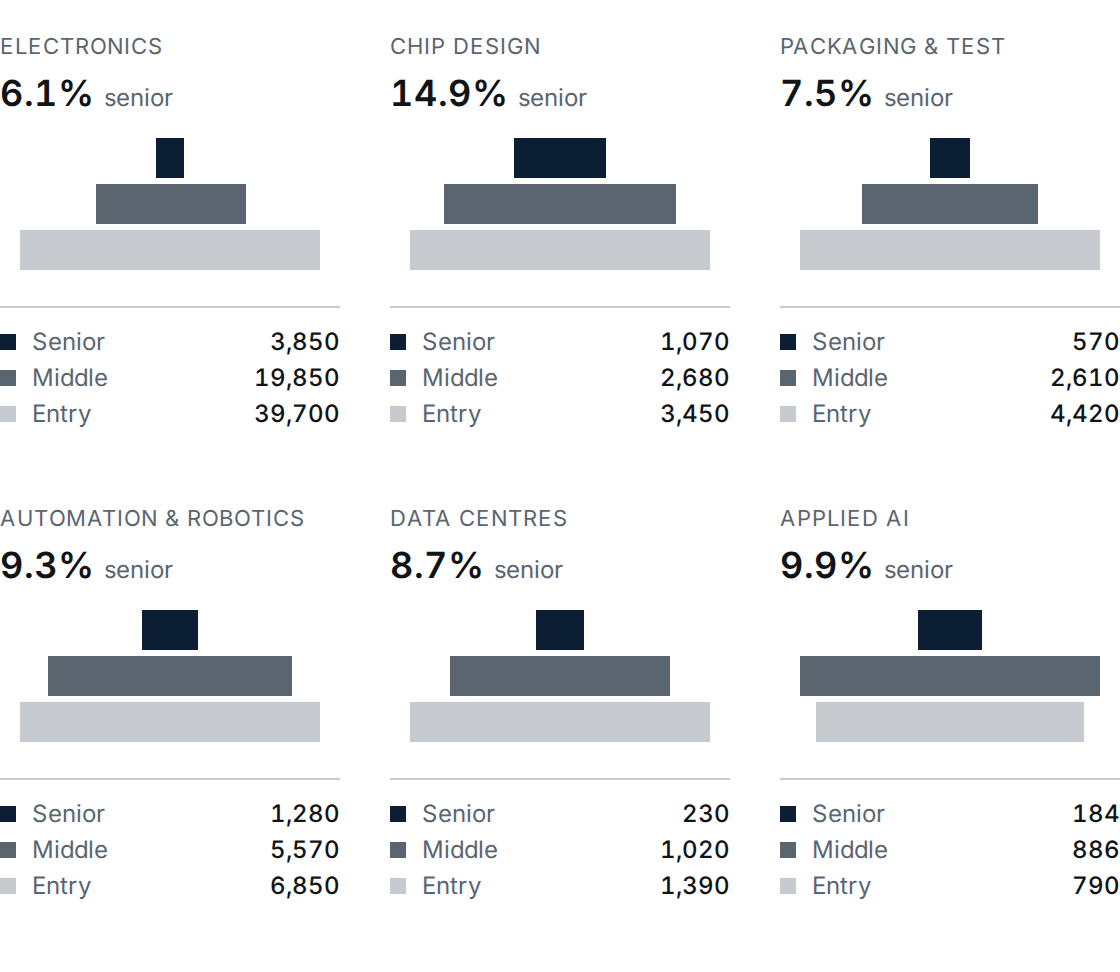
Entry, middle and senior engineers by sector. Senior share of each sector shown under its name.
| Sector | Engineers | Entry | Middle | Senior | Senior share | Entry per senior | Vietnamese at senior |
|---|---|---|---|---|---|---|---|
| Electronics | 63,400 | 39,700 | 19,850 | 3,850 | 6.1% | 10.3 : 1 | 58% |
| Semiconductors: chip design | 7,200 | 3,450 | 2,680 | 1,070 | 14.9% | 3.2 : 1 | 82% |
| Semiconductors: packaging & test | 7,600 | 4,420 | 2,610 | 570 | 7.5% | 7.8 : 1 | 55% |
| Industrial automation & robotics | 13,700 | 6,850 | 5,570 | 1,280 | 9.3% | 5.4 : 1 | 81% |
| Data centres | 2,640 | 1,390 | 1,020 | 230 | 8.7% | 6.0 : 1 | 61% |
| Applied AI in manufacturing | 1,860 | 790 | 886 | 184 | 9.9% | 4.3 : 1 | 74% |
| Total | 96,400 | 56,600 | 32,616 | 7,184 | 7.5% | 7.9 : 1 | 66% |
Ratios and shares are computed from the counts shown and rounded. Vietnamese at senior is the share of senior seats held by Vietnamese nationals.
Reading each sector
Electronics: the largest sector, the steepest pyramid
63,400 engineers: 66% of the map, but 54% of the senior level. There are 10.3 entry engineers for every senior, the highest ratio of the six. 58% of senior seats are held by Vietnamese nationals. The roughly 1,600 foreign seniors here are two in three of all foreign seniors across the five sectors.
One public reference point: Samsung R&D Center Vietnam reported about 2,500 Vietnamese engineers in May 2026.
Semiconductors: two pyramids under one name
Chip design: 7,200 engineers, 14.9% at senior level, 3.2 entry engineers per senior, 82% Vietnamese at senior. Packaging and test: 7,600 engineers, 7.5% at senior level, 7.8 entry engineers per senior, 55% Vietnamese at senior. About 257 of the 570 senior seats in packaging and test are held by foreign engineers, against 193 of 1,070 in chip design.
Public figures put the workforce close to these totals: around 7,000 engineers in IC design and 7,000–8,000 in packaging, testing, materials and semiconductor equipment (national steering committee, reported December 2025). The government strategy (Decision 1018/QD-TTg, September 2024) targets more than 50,000 semiconductor engineers and graduates by 2030.
The target counts engineers and graduates. This map counts working engineers by level. The two are not the same measure. Still, the distance between 14,800 and 50,000 is worth holding in mind. A training target counts graduates; senior seats are held by people who have owned a line or a design for years.
Industrial automation and robotics: a wide middle
13,700 engineers. The middle level is 41% of the sector (5,570), against 31% in electronics. Senior share is 9.3%, against 6.1% in electronics.
If one in five middle engineers moved up to senior, the senior level would grow by about 1,100, from 1,280 to about 2,400. That is a what-if to show the size of the pipeline, not a forecast.
Applied AI in manufacturing: the one sector that bulges in the middle
1,860 engineers. The middle level (886) is larger than the entry level (790), the only sector of the six where that is true. 184 engineers are at senior level, 9.9% of the sector and the second-highest share after chip design (14.9%). About one in four of those seats is held by a foreign engineer (26%).
The profile counted here is not machine learning alone, but machine learning that runs inside a production process.
Data centres: small, and the senior level is still forming
2,640 engineers across design, construction and operation; the power grid is excluded. 6.0 entry engineers per senior. 230 engineers at senior level, 3.2% of all seniors in the map. 39% of those seats are held by foreign engineers, about 90 people.
For the direction of the sector: CBRE Vietnam reported 104 MW of operational data centre capacity in November 2025 and projects a 5.6-fold increase from that level, with a horizon of 2030.
Who holds the senior seats
Across the six pyramids, 66% of senior seats are held by Vietnamese nationals, including engineers who returned from abroad. The range runs from 55% in packaging and test to 82% in chip design.
About 2,450 senior engineers are foreign nationals. Two in three of them work in electronics.
Where the foreign seniors sit
| Sector | Foreign seniors | Share |
|---|---|---|
| Electronics | 1,617 | 66% |
| Semiconductors: packaging & test | 257 | 10% |
| Industrial automation & robotics | 243 | 10% |
| Semiconductors: chip design | 193 | 8% |
| Data centres | 90 | 4% |
| Applied AI in manufacturing | 48 | 2% |
The gap is not about ability. A senior level takes years to form: someone has to own a line, a process or a product long enough for it to count. The gap will close. The question is how fast.
What this map does not say
- Sector totals are calibrated to public figures where they exist: semiconductor workforce, large R&D centres, data centre capacity. No public source counts engineers by scope of ownership, or by nationality at senior level. The split into entry, middle and senior, and the Vietnamese share at senior level, are Kelson estimates built from market observation.
- Small cells (184 in applied AI, 230 in data centres) are the least certain figures. Read them as “a few hundred”, not as exact counts.
- The map covers five sectors. It does not count technicians and operators, software engineers outside these sectors, or engineers in other sectors.
- Data centres covers design, construction and operation. It excludes the power grid.
- Returned overseas Vietnamese count as Vietnamese. Foreign means non-Vietnamese nationals working in Vietnam.
- The map describes 2026. It will be revised as public data changes. If a number looks wrong, write to Kelson.
Where Kelson works
Kelson's searches start at the senior level of these five sectors. With about 7,200 people at senior level nationwide, finding the right one is not a matter of screening CVs.
A title says where someone sat — not what they did there. Kelson starts from the work: which line, which design, which system someone owned, and whether it ran. Kelson reads what someone has actually done — not what the title says, or how well they say it.
If you own a whole line, process or product area in one of these sectors, you are inside the 7,184. You do not need to send a CV to talk.
Sources
- • Vietnam+ / VNA, 9 December 2025 — semiconductor workforce estimates (national steering committee)
- • Government of Vietnam, Decision 1018/QD-TTg, 21 September 2024 — semiconductor industry development strategy (workforce targets)
- • Vietnam+, 15 May 2026 — Samsung R&D Center Vietnam, about 2,500 Vietnamese engineers
- • CBRE Vietnam, Data Center in Vietnam 2025, 11 November 2025 — 104 MW operational capacity
Published 30 September 2026
Published by Kelson.